

Carr Shines, Michigan Survives Rutgers, Questions Will Remain
Michigan won Saturday, beating Rutgers 28-21 behind an impressive performance from freshman quarterback Tommy Carr. Whether the Wolverines accomplished much beyond improving their record to 5-3 is another question.
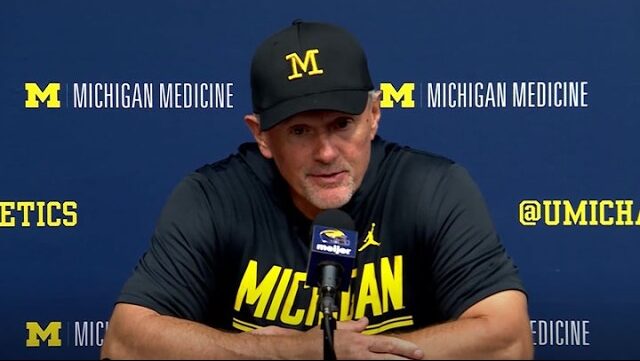
Coming off an embarrassing loss to Indiana, Michigan had an opportunity to quiet some of the criticism surrounding Kyle Whittingham and his coaching staff. Rutgers offered a favorable matchup for an offense that has struggled throughout the season, and at times the Wolverines appeared to find answers.
The game also reminded everyone why Michigan entered the weekend with a 4-3 record.
The Wolverines outgained Rutgers 427-249, held a 23-9 first-down advantage, converted 12 of 16 third downs, and controlled possession for nearly 36 minutes. Rutgers quarterback AJ Surace completed just three passes all afternoon.
Somehow, Michigan still found itself tied at 21 midway through the fourth quarter.
Two missed field goals, seven penalties for 90 yards and a handful of enormous defensive breakdowns nearly spoiled what was otherwise an encouraging afternoon for Carr and several of Michigan’s offensive playmakers.
The final statistics suggest a considerably more convincing performance than what actually unfolded.
Carr delivers in second start
Carr deserves plenty of credit for how Michigan moved the football Saturday.
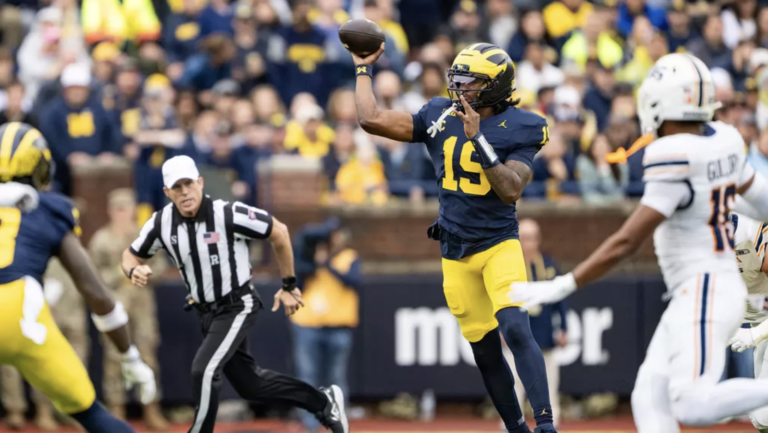
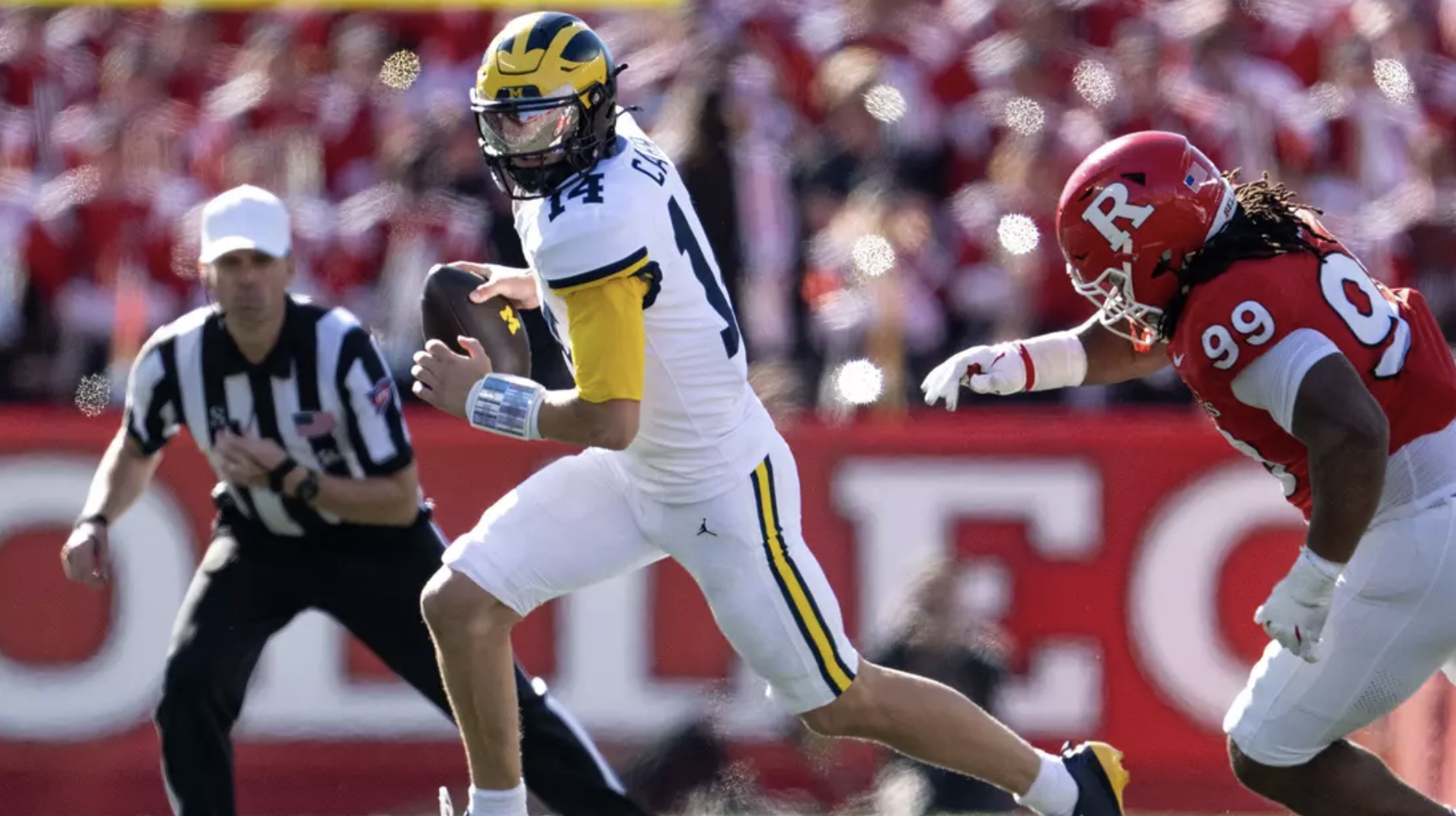
The freshman completed 22 of 27 passes for 266 yards and a touchdown, adding 54 rushing yards and two scores. He looked increasingly comfortable operating the offense, particularly when working through his progressions and navigating pressure.
His pocket presence was impressive, and he consistently made good decisions about when to deliver the football and when to scramble. Carr also showed a willingness to attack downfield, something Michigan’s offense has lacked for much of the season.
One of his best throws came on third-and-7, when he gave JJ Buchanan an opportunity to make a contested 30-yard reception. The two also connected on a 6-yard touchdown in the first quarter.
Carr was at his best when Michigan needed him most.
With the game tied at 21, Carr led a 12-play, 75-yard touchdown drive that took more than seven minutes. He converted third-and-3 with a 16-yard completion to Hogan Hansen, found Hansen again for 14 yards on third-and-10 and eventually scrambled 9 yards for the go-ahead touchdown on third-and-7.
Michigan later needed another first down to close out the game, and Carr picked it up with a quarterback sneak on third-and-1.
It was an impressive performance for a true freshman making his second career start, especially considering the offensive problems around him.
Carr’s success also shouldn’t become another indictment of Bryce Underwood. The quarterback change has been treated as an answer to Michigan’s struggles, but Saturday offered further evidence that the bigger problems have been personnel and the offensive approach, not any one player behind center.
Offensive line still holding Michigan back
Michigan finished with 161 rushing yards, although Carr accounted for 54 of them and the Wolverines averaged just 3.6 yards per carry.
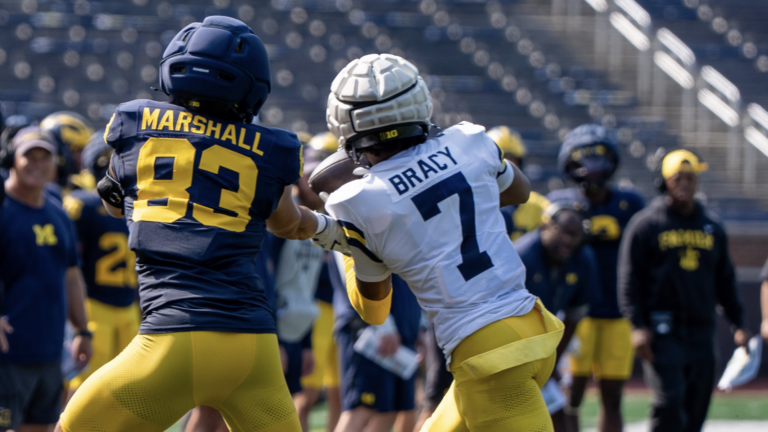
Jordan Marshall, who has been dealing with injuries throughout the season, finished with zero yards on five attempts. He looked limited before Michigan leaned more on Savion Hiter, who finished with 76 yards on 20 carries.
Hiter ran hard and provided some encouraging moments, particularly in the second half, while Bryson Kuzdzal added 37 yards on six attempts.
The offensive line made their work unnecessarily difficult.
Michigan continued to struggle creating consistent running lanes, and the protection wasn’t particularly convincing despite Carr being sacked only once. Rutgers generated pressure without regularly needing to bring additional defenders.
One sequence late in the first half illustrated the frustration with Jason Beck’s offensive approach. Facing third-and-15, Michigan brought out its Rhino package and motioned to the right, only to allow pressure against a three-man rush.
The Wolverines had already shown how effective they could be spreading the field and letting Carr distribute the football. Yet Beck continued returning to the heavy personnel packages that have produced so little throughout the season.
Michigan’s opening drive of the second half offered a useful comparison. Without using Rhino, the Wolverines marched 75 yards in 11 plays, converted three third downs and scored on Carr’s 15-yard scramble.
There were some promising developments along the offensive line, particularly from Avery Gach, who played well replacing the injured Brady Norton. Gach deserves serious consideration for the starting right guard job moving forward.
If Andrew Babalola is healthy, the staff should also give him an opportunity to compete for playing time.
Michigan has struggled with the same blocking issues for eight games. At some point, the staff needs to reassess the personnel rather than continuing to expect different results.
Third-down success provides reason for optimism
For all the offensive frustrations, Michigan’s third-down performance was outstanding.
The Wolverines converted 12 of 16 opportunities, including six of eight requiring four yards or fewer. Their average third-down distance was 5.3 yards, a notable improvement in the situations Michigan has consistently struggled to create.
When the Wolverines stayed on schedule, the offense looked considerably more functional. Carr had manageable situations to work with, the running backs were able to move the chains, and Michigan sustained possessions without needing to rely entirely on explosive plays.
The tight ends were also more effective than they have been in recent weeks.
Hansen finished with three catches for 42 yards, including two important third-down conversions on the go-ahead touchdown drive. Jalen Hoffman added two receptions for 17 yards.
Buchanan and Andrew Marsh both surpassed 1,000 career receiving yards during the game, a well-deserved milestone for two of Michigan’s most reliable offensive players. Buchanan caught five passes for 63 yards and a touchdown, while Marsh added seven receptions for 51 yards.
Salesi Moa continued to show his potential with a 44-yard reception, and Channing Goodwin contributed as a blocker. Travis Johnson had a costly third-down drop, but the receiving group generally performed well.
Michigan has the personnel to produce more consistently through the air, and Saturday’s performance showed what Carr can accomplish when he’s allowed to use those weapons.
Defensive breakdowns nearly prove costly
Jay Hill’s defense had an unusual afternoon.
Rutgers completed only three of 12 passes for 123 yards, with all three completions coming in the first half. Michigan has now held opponents without a second-half completion in consecutive games, although Indiana managed one in overtime last week.
That makes Rutgers scoring 21 points all the more remarkable.
An 80-yard touchdown pass to Jourdin Houston on third-and-15 and a 54-yard run by Antwan Raymond accounted for 134 of Rutgers’ 249 total yards. Michigan had opportunities to end both possessions before the explosive plays and failed to finish.
The absence of injured defensive ends John Henry Daley and Dom Nichols was significant, though several players performed well in their place.
Benny Patterson finished with seven tackles and a tackle for loss, while Chris Bracy continued his outstanding season with six tackles, a sack and a tackle for loss. Bracy has made a strong case as Michigan’s best defensive player this year.
Questions remain about the defensive rotation, particularly the limited involvement of Nate Marshall and the apparent absence of Carter Meadows from the action.
Michigan’s defense remains the strength of this team, and its ability to consistently shut down opposing passing attacks has been remarkable. Saturday’s explosive breakdowns, however, kept an overmatched Rutgers offense in a game it otherwise struggled to sustain drives in.
Plenty left to fix
Michigan scored touchdowns on four possessions, including drives of 92, 75, 75 and 75 yards. The Wolverines also missed field goals from 48 and 35 yards, committed seven penalties and needed Carr to bail out several possessions.
The offensive improvement was real, particularly in the passing game and on third down. Michigan also found more success running the ball as the afternoon progressed.
But the offensive line remains a major concern. The coaching staff keeps leaning on questionable formations and schemes, and the Wolverines still make too many mistakes to put teams away.
Against Rutgers, those issues nearly cost Michigan another game.
Carr’s performance should give the Wolverines confidence in their young quarterback, and there were individual efforts worth celebrating. The broader evaluation of Whittingham’s first season, however, hasn’t changed much.
Michigan has enough talent to be better than what it has shown through eight games. The Wolverines have consistently demonstrated that in stretches, often within the same afternoon.
They also continue to make winning football games considerably more difficult than necessary.
Saturday’s victory was important for a team trying to get its season back on track, but beating Rutgers by seven points is unlikely to ease the pressure on this coaching staff.
Carr took a meaningful step forward in Piscataway. Michigan still has plenty of work to do.