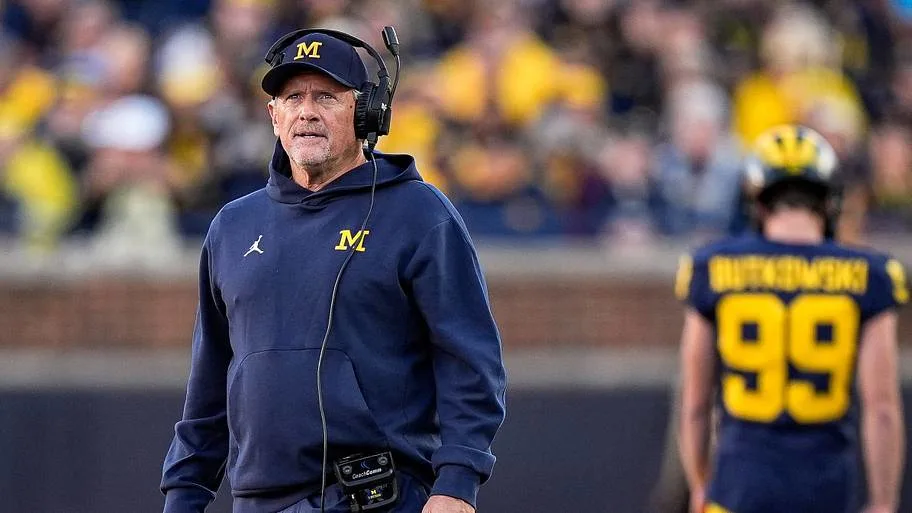
Michigan wastes dominant defensive effort in overtime loss to Indiana as offensive failures continue
Michigan changed quarterbacks, promised offensive adjustments, and appeared to find something that worked in the second half against Penn State.
One week later, the Wolverines were right back where they started.
The same questionable formations. The same slow-developing perimeter runs. The same protection problems. And another miserable offensive performance that not even an exceptional effort from Jay Hill’s defense could overcome.
Michigan fell to Indiana 13-6 in overtime Saturday, failing to score a touchdown despite holding the Hoosiers to 187 yards and six points through regulation.
Indiana didn’t complete a single pass in the second half. Josh Hoover’s only completion after halftime came on the first play of overtime, a 21-yard gain that set up the game-winning touchdown.
Meanwhile, Michigan reached the Indiana 23, 1, 11 and 3 on four separate possessions and managed just six points.
The Wolverines needed one touchdown in regulation to win a game their defense had controlled.
They couldn’t find it.
And while Tommy Carr certainly contributed to those failures, Saturday’s loss raises serious questions about offensive coordinator Jason Beck and head coach Kyle Whittingham.
Different quarterback, same offense
The circumstances leading into Saturday made Michigan’s performance particularly frustrating.
After the Minnesota loss, Whittingham and Beck had a full bye week to evaluate an offense struggling with predictable formations, horizontal rushing concepts, and an inability to sustain drives.
They talked about making adjustments.
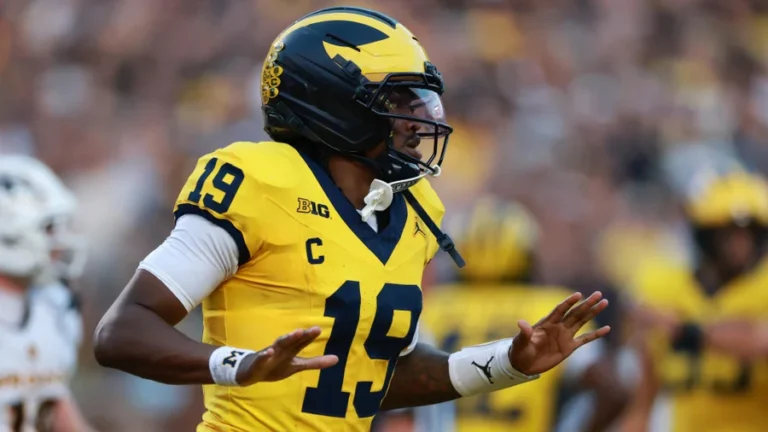
Michigan then delivered perhaps its worst offensive half of the season against Penn State. Bryce Underwood threw two interceptions and was benched at halftime.
Carr entered, and the offense suddenly looked different. Michigan leaned more on zone concepts and interior runs, finding success with a simpler approach.
The Wolverines scored 21 points in the second half and rallied to win.
It appeared the staff had finally found something worth building around.
Instead, Beck returned to many of the same concepts against Indiana.
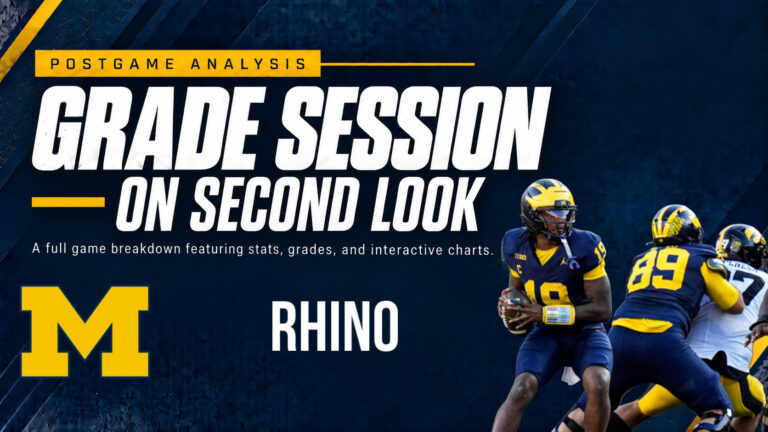
Michigan opened with heavy RHINO personnel, featuring Jalen Hoffman and Eli Owens, and continued using those packages throughout the first half.
Michigan repeatedly called play action from RHINO while keeping a running back in protection, leaving just three eligible receivers actually running routes.
Against an Indiana defense generating pressure, Carr was frequently left searching for somewhere to throw with limited options available.
The running game wasn’t much better.
Bryson Kuzdzal lost seven yards on an end-around. Jordan Marshall later lost five on a pitch. Both were examples of the slow-developing perimeter runs that have plagued Michigan throughout the season.
Beck also introduced a two-quarterback package with Underwood taking the snap and Carr split out wide. Indiana immediately diagnosed the run, dropping Underwood for a one-yard loss.
On the next play, Carr threw into heavy coverage. The pass was tipped and intercepted by Amare Ferrell, who returned it to the Michigan 21.
It was Carr’s second turnover after an earlier fumble.
Both turnovers gave Indiana possession inside Michigan’s 30, and both resulted in field goals.
Whittingham has repeatedly emphasized turnovers as one of Michigan’s biggest problems. They contributed to the decision to bench Underwood against Penn State.
But Carr’s struggles should reinforce something the staff needs to recognize.
Michigan’s offensive problems were never just about Underwood.
Changing quarterbacks doesn’t fix an offense that repeatedly puts its players in difficult situations.
Four sacks, all on third down
Nothing better illustrates Michigan’s offensive failures than its inability to finish drives.
Carr was sacked four times for 36 yards. Every sack came on third down, and three occurred deep in Indiana territory.
Late in the second quarter, Michigan reached the Indiana 23 before Carr took a 12-yard sack on third-and-3. Trey Butkowski subsequently missed a 53-yard field goal.
The most damaging sequence came on Michigan’s opening possession of the third quarter.
For the first time all afternoon, the Wolverines looked capable of moving the football consistently. Carr completed consecutive 17-yard passes to JJ Buchanan, found Hogan Hansen for another 12 yards and helped Michigan march 63 yards in 12 plays.
Michigan converted fourth-and-1 with a straightforward Marshall run up the middle and eventually reached the Indiana 1.
Then Beck called a naked bootleg on third-and-1. Indiana wasn’t fooled.
Tobi Osunsanmi sacked Carr for a 13-yard loss, and Butkowski missed a 32-yard field goal.
Eight minutes of possession. Sixty-three yards. Zero points.
Why abandon the approach that had worked, gaining just one yard to get near the goal line?
With 7:32 remaining, Michigan took over at its own 39 and finally found some rhythm.
Carr delivered a 24-yard completion to Channing Goodwin on third-and-10 and later connected with Buchanan for seven yards on third-and-3.
The Wolverines mixed in interior runs, operated with tempo and worked their way to the Indiana 3.
With Indiana holding just one timeout, Michigan had a chance to score the winning touchdown with little time to respond.
Instead, Carr was sacked for a five-yard loss on third-and-3.
Butkowski’s 26-yard field goal as regulation expired forced overtime, but it also turned a potential touchdown into three points.
Michigan finished with just 57 rushing yards on 42 attempts, including sacks.
Marshall led the running backs with 26 yards on 12 carries. Savion Hiter managed 15 yards on 10 attempts, while Kuzdzal added 11 yards on four carries.
Carr completed 20 of 32 passes for 167 yards and an interception.
The offensive line also deserves scrutiny, particularly the decision to start Brady Norton and Marky Walbridge on the right side while Avery Gach remained out of the starting lineup.
Walbridge was beaten for a third-down sack in the fourth quarter, and protection breakdowns repeatedly destroyed scoring opportunities.
Carr needs to improve his pocket awareness and decision-making. But the staff also needs to provide better answers.
Jay Hill deserved better
While Michigan’s offense continued to swim in futility, Hill’s defense delivered a winning performance. Worthy of so much more.
Michigan may have the nation’s best defense, and it is being wasted.
The Wolverines were without Rod Moore and Dominic Nichols, while Enow Etta entered the game as a question mark before ultimately starting.
Michigan pressured Hoover from the opening possession, disrupted Indiana’s passing game and repeatedly won critical downs.
Hoover completed just seven of 17 passes for 60 yards during regulation. He didn’t complete a pass in the second half. Indiana managed only 49 total yards after halftime.
Chris Bracy was outstanding, finishing with 13 tackles, including nine solo stops and a tackle for loss.
Nathaniel Staehling added seven tackles, while Zeke Berry recorded six and an interception. Jyaire Hill contributed two important pass breakups.
Berry delivered Michigan’s biggest takeaway late in the third quarter, intercepting Hoover and returning the ball 37 yards to the Indiana 13.
It should have been the breakthrough Michigan needed.
Instead, the offense gained two yards and settled for a 29-yard field goal.
The defense kept giving Michigan opportunities.
Smith Snowden recorded a critical third-down sack early in the fourth quarter. Bracy later stopped Lee Beebe Jr. a yard short on third-and-2, forcing another punt.
On Indiana’s next possession, Mason Curtis and Staehling combined to stop Turbo Richard for no gain on third-and-2.
Another punt.
Hill consistently adjusted to Indiana’s approach, and his players responded.
The Hoosiers finally broke through in overtime. Hoover connected with Brock Schott for 21 yards before running four yards for the touchdown.
Michigan’s response ended with an incomplete pass on fourth-and-9 from the Indiana 13.
The defense finally allowed a touchdown after four quarters of extraordinary work.
The offense never scored one.
Beck and Whittingham have to answer for this
Saturday shouldn’t become a referendum on whether Carr or Underwood should be Michigan’s quarterback.
Carr made mistakes. His turnovers were costly, and taking four third-down sacks is unacceptable. He also delivered important throws and nearly guided Michigan to a late victory.
But Michigan continues to struggle with two different quarterbacks operating the same system.
Whittingham has publicly acknowledged the need to run the football more effectively between the tackles.
Yet Michigan keeps returning to perimeter concepts and heavy personnel groupings that haven’t consistently produced.
Beck is responsible for the play calling. Whittingham is responsible for making sure the offense is headed in the right direction.
And the Wolverines keep repeating the same mistakes.
The contrast between Michigan’s coordinators Saturday couldn’t have been clearer.
Hill had an aggressive plan, adjusted when Indiana changed its approach and consistently put his players in position to succeed.
Beck’s offense repeatedly returned to concepts that have failed all season, even after showing against Penn State that a different approach could work.
Michigan finished with 224 yards, six points and zero touchdowns on 13 offensive possessions.
The Penn State comeback briefly suggested the Wolverines had found a way forward after benching Underwood. Saturday was a reminder that changing quarterbacks doesn’t automatically change an offense.
Until Beck and Whittingham fix the problems they’ve spent weeks acknowledging, Michigan will keep wasting performances like the one its defense delivered against Indiana.
The Wolverines didn’t need a great offense to win Saturday. They needed one capable of scoring a single touchdown in regulation.
They didn’t have one.